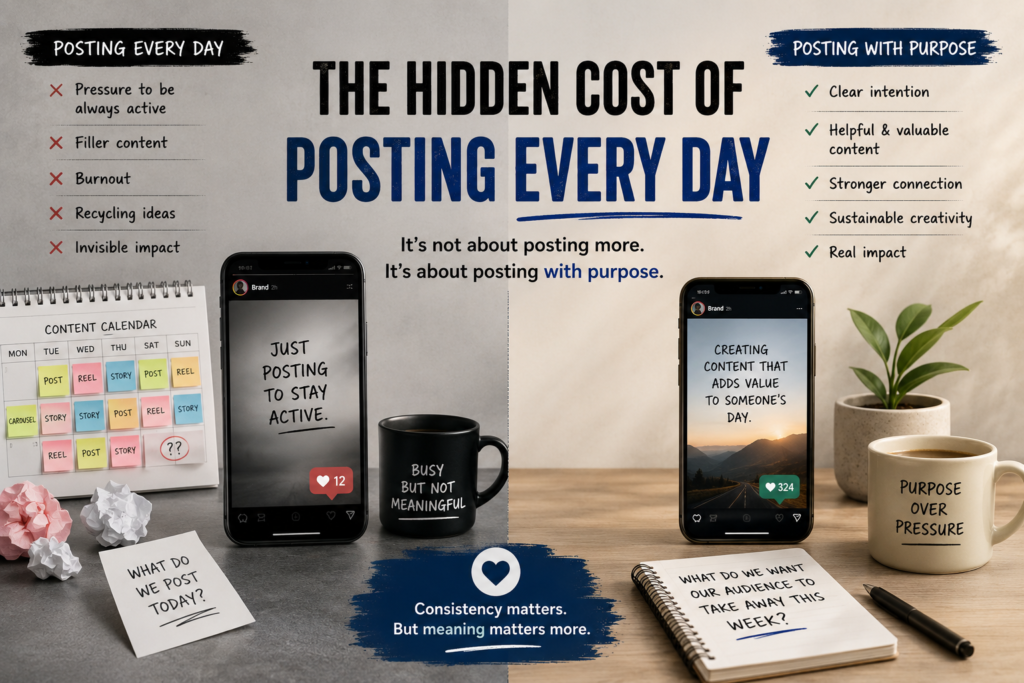
The Hidden Cost of Posting Every Day
There’s a piece of advice almost every social media manager has heard:
“You need to post consistently.”
And it’s not wrong.
Consistency helps a brand stay visible. It gives your audience something to come back to. It also helps you understand what kind of content works over time.
But somewhere between “post consistently” and “post every day,” we started treating frequency as a measure of good social media marketing.
That’s where things get interesting.
Because posting every day has a cost that doesn’t always show up in your analytics.
The pressure to always have something to post
When you manage social media, an empty content calendar can feel like a problem.
Monday: Reel.
Tuesday: Carousel.
Wednesday: Story.
Thursday: Trend.
Friday: Educational post.
And then comes Saturday.
“Okay… what are we posting today?”
So you create something.
Not because you have something valuable to say, but because the calendar says there should be something there.
This is how content starts becoming filler.
And filler isn’t always obvious.
It can look polished.
It can have good design.
It can use a trending audio.
It can even get decent engagement.
But if your audience doesn’t actually need it, you’re spending time creating content that doesn’t move the brand forward.
Your audience has limited attention too
We often talk about how brands need to fight for people’s attention.
But there’s another side to this.
Your audience has limited attention.
If a brand constantly appears on someone’s feed without giving them anything useful, interesting, entertaining or meaningful, eventually they stop noticing it.
Being visible doesn’t automatically mean being memorable.
Sometimes, posting less can actually make your content feel more intentional.
Not because your audience is sitting around waiting for your next post.
But because every piece of content has a reason to exist.
The cost isn’t just time
When people talk about the cost of social media content, they usually think about money.
Designer fees.
Video editing.
Ads.
Software.
Content creators.
But there’s another cost:
Creative energy.
Coming up with ideas every single day is exhausting, especially when you’re trying to make every post different.
Eventually, you start recycling the same ideas.
The same hooks.
The same trends.
The same “3 tips” format.
And you may not even notice it until your content starts feeling like everything else on the internet.
That’s not necessarily a consistency problem.
It’s a creative sustainability problem.
Startups feel this even more
For a startup, this can be especially tricky.
You already have limited time, people and resources.
Your social media shouldn’t become another machine that constantly demands content just for the sake of staying active.
Instead, your content should support something bigger.
Maybe you’re trying to build awareness.
Maybe you’re trying to establish credibility.
Maybe you’re educating people about a product that nobody knows exists yet.
Maybe you’re trying to build a community.
Whatever the goal is, your content should have a job.
Otherwise, you’re just keeping the account busy.
What if we stopped asking, “How often should we post?”
This is probably the question I would change first.
Instead of asking:
“How many times should we post this week?”
Ask:
“What do we actually want our audience to take away this week?”
That small change can completely change your content strategy.
Maybe you only have three genuinely good ideas.
Post those three.
Maybe you have one excellent idea that deserves more attention.
Give it that attention.
Maybe you don’t have anything useful to say today.
That’s okay too.
The internet will survive one day without your brand posting.
Consistency still matters
I’m not saying brands should disappear for weeks and call it a strategy.
Consistency is important.
But I think consistency should be about the value you provide, not just the number of times you hit “publish.”
A brand that consistently teaches, entertains, helps or starts conversations is doing something meaningful.
A brand that consistently posts just to maintain a streak is doing something else entirely.
And those two things can look very similar from the outside.
Maybe the goal isn’t “more content”
Maybe the goal is better reasons to care.
Before creating your next post, ask yourself:
Why does this need to exist?
If you have a good answer, create it.
If you don’t…
Maybe that’s the content calendar telling you to take a breath.
Because social media doesn’t reward brands simply for being busy.
It rewards brands that give people a reason to stop scrolling.
Post less for the sake of posting.
Create more for the sake of meaning.