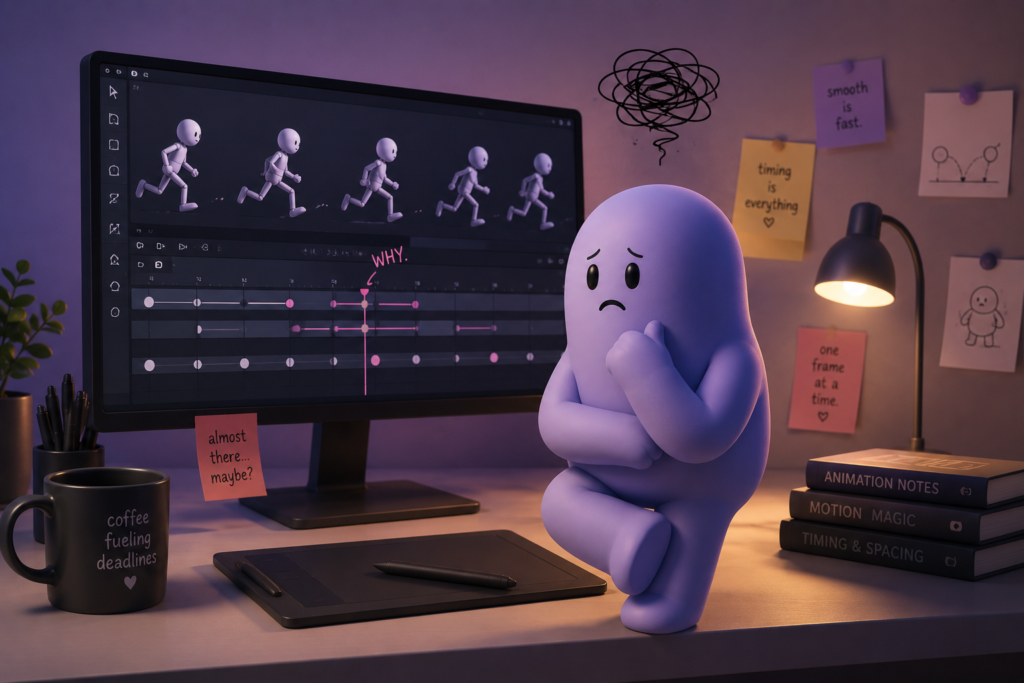
Why Your Animation Feels… Weird
You added the easing.
You added the motion blur.
You added a few more keyframes because… surely that will fix it.
And somehow, your animation still feels like a PowerPoint presentation that discovered caffeine.
So what went wrong?
Usually, it’s not the software.
It’s the movement.
Animation isn’t about making things move.
It’s about making movement feel intentional.
A ball falling from a height shouldn’t move the same way a logo appearing on screen does. A character turning their head shouldn’t have the same timing as a button popping up.
Everything has a reason to move the way it does.
Timing matters. A lot.
Imagine someone saying:
“I have something important to tell you.”
…and then waiting three seconds before saying it.
You’d probably start wondering what happened.
Animation works the same way.
Too slow → boring.
Too fast → confusing.
Just right → oh, that felt good.
That’s why timing and spacing are some of the first things I look at when an animation feels “off.”
And then there’s anticipation.
Before something happens, we usually get a tiny hint that it’s about to happen.
A character bends their knees before jumping.
A button slightly shifts before being clicked.
A ball squashes before it launches.
These tiny details make movement feel believable.
Without them, animation can feel like objects are simply teleporting between keyframes.
The biggest mistake?
Trying to fix bad movement with more movement.
More effects.
More transitions.
More particles.
More everything.
Sometimes the best animation decision is simply:
remove something.
Because good animation isn’t about showing how many things you can animate.
It’s about knowing what actually needs to move.
And yes, I still occasionally add unnecessary keyframes.
I’m working on it.
One keyframe at a time.