The Tiny Details That Make Animation Feel Alive
Have you ever watched an animation and thought:
“Okay… why does this look so satisfying?”
Nothing dramatic happened.
No explosions.
No 47 transitions.
No suspicious amount of glow.
It just… felt good.
That’s usually because of the tiny details.
The secret is in the little things.
A character doesn’t just walk.
Their body shifts.
Their hair moves slightly.
Their clothes react.
Their weight changes from one foot to another.
Suddenly, the character feels like an actual person instead of a collection of polygons having a difficult day.
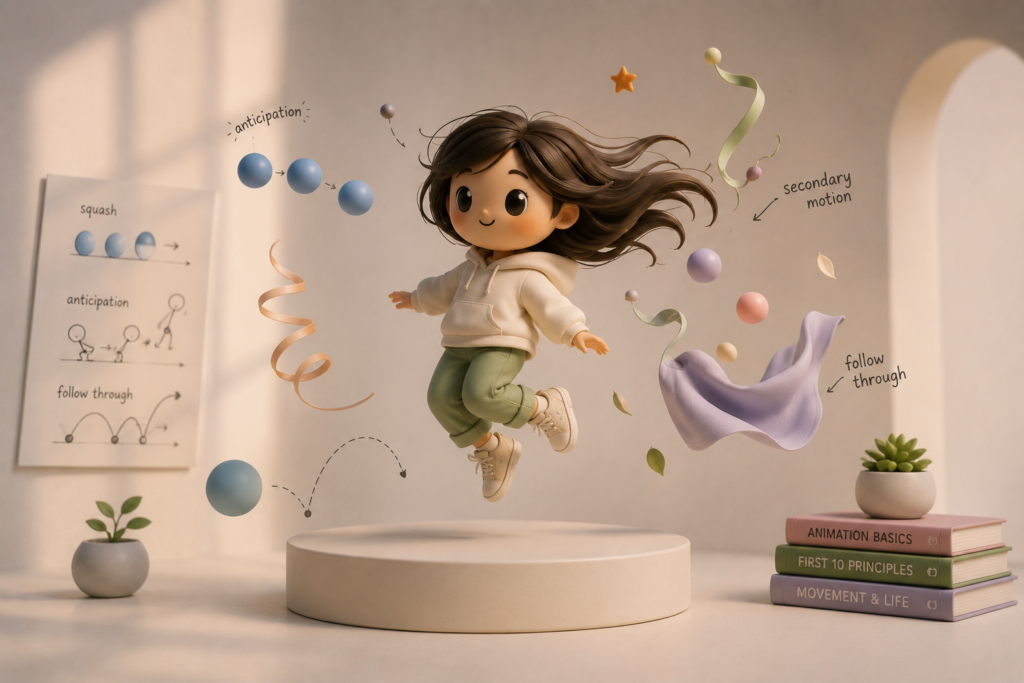
Squash and stretch.
One of my favourite little animation principles.
A bouncing ball becomes slightly wider when it hits the ground and stretches as it moves upward.
It’s a tiny change.
But suddenly:
BOING.
The ball has personality.
Then there’s secondary motion.
Imagine someone running.
Their arms move.
Their legs move.
But their hair?
Their clothes?
Their bag?
They don’t immediately stop when the person stops.
That’s secondary motion.
It makes movement feel connected to the real world.
And honestly, this is where things start getting fun.
But here’s the thing…
You don’t need to animate everything.
Actually, please don’t.
If every single element on screen is moving at the same time, your audience’s eyes are going to start filing complaints.
Good animation has hierarchy.
Something leads.
Something follows.
Something stays still.
And that contrast makes the movement more interesting.
My favourite animation rule?
Make people notice the movement without making them notice the work behind it.
If someone watches your animation and thinks,
“Wow, that movement felt natural.”
instead of
“Wow, that’s a lot of keyframes.”
you’ve probably done something right.
The best animation sometimes hides how much work went into it.
And that’s kind of the magic.